
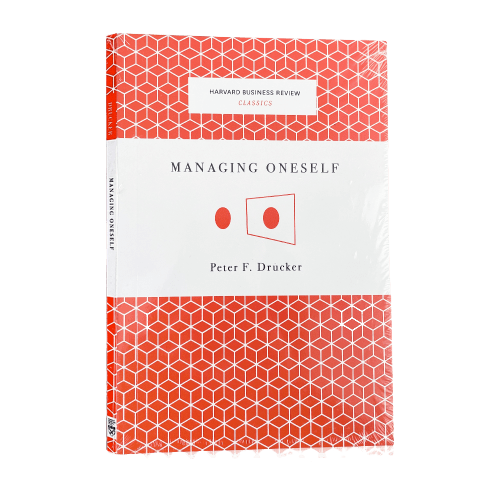
Managing Oneself by Peter F. Drucker teaches how to become better at self-management. The book helps you identify your strengths and come up with an actionable plan to improve your life. When applied, lessons from this book can improve your relationships, skills, plans, and much more.
What Are My Strengths?
To even have a modest expectation for success, we need to learn to manage ourselves like some of history’s great achievers. This means placing ourselves where we can make the greatest contribution.
Most people don’t know what they are good at even though we can only perform from a position of strength.
The way to discover your strength is through feedback analysis. When you make a key decision, write down what you expect to happen and then compare it with your expectations nine months or a year later.
If you practice feedback analysis consistently, you will soon know where your strengths lie.
Implications of feedback analysis:
- Concentrate on your strengths. Put yourself where your strengths can produce results
- Work towards improving your strengths. The analysis will show you where you need to improve on your skills or acquire new ones
- Discover your intellectual arrogance. Get skills and knowledge in areas that you are weak in
“One should waste as little effort as possible on improving areas of low competence.”
How Do I Perform?
Few people know how they get things done. How well you perform is a more important question than what your strengths are.
How you perform can be determined by a few personality traits:
- Are you a reader or a listener? Readers are great at getting the facts but not at articulating their opinions
- How do you learn? How you learn determines how you perform
- Do you work well with people or are you a loner? Some people excel well only when they work with others
- Are you an adviser or a decision-maker? How well do you produce results? By advising others or taking the initiative?
- Do you perform well under stress? Or do you need a highly structured environment?
- Do you perform well in a small or a large organization? Some people work well in either organization
What Are My Values
The mirror test: Ask yourself: “What kind of person do I want to see in the morning when I look in the mirror?”
“To work in an organization whose value system is unacceptable or incompatible with one’s own condemns a person both to frustration and non-performance.”
Your strengths and the way you perform have to complement each other.
For example:
Over the years, I developed systems to allow me to focus on what I am good at
Where Do I Belong?
Most people don’t know where they belong.
To know where you belong find answers to these three questions:
- What are my strengths?
- How do I perform?
- What are my values?
In your mid-twenties, you should have decided where you don’t belong. It is easier to exclude alternatives than to decide on only one. By knowing where you belong, you will be able to approach opportunities with the right expectations.
“Successful careers are not planned. They develop when people are prepared for opportunities because they know their strengths, their method of work, and their values.”
What Should I Contribute?
Ask yourself: “What contribution can I make?”
To answer this question, you need to know the 3 answers to “Where I Belong” plus:
- What the situation requires
- How to make the greatest contribution. Identify the areas with the greatest potential to make an impact
- Results to be achieved to make a difference. When will you be satisfied with your results?
“To aim at results that cannot be achieved—or that can be only under the most unlikely circumstances—is not being ambitious; it is being foolish. Second, the results should be meaningful. They should make a difference. Finally, results should be visible and, if at all possible, measurable.”
Responsibility for Relationships
Most people are only effective when they work with other people. To properly manage yourself, you have to take responsibility for relationships.
To be effective you must know the strengths and weaknesses of your co-workers. When working for a boss, it is upon you to adapt yourself in ways that make your boss the most effective.
The second part of being effective is taking responsibility for communication. Conflicts arise because people don’t take their responsibilities seriously enough.
“Organizations are no longer built on force but trust. The existence of trust between people does not necessarily mean that they like one another. It means that they understand one another. Taking responsibility for relationships is, therefore, an absolute necessity.”
The Second Half of Your Life
In the old days when everyone was doing manual labour, there was no point in preparing for a second life. Nowadays, it is very common to change careers or to start a side business.
There are three ways to develop a second career:
- Start one. Quit your job and shift your entire focus to your new career
- Develop a parallel career. Split your time between two or more careers
- Become a social entrepreneur e.g by starting a non-profit
“People who manage the second half of their lives may always be a minority. The majority may “retire on the job” and count the years until their actual retirement. But it is this minority, the men and women who see a long working-life expectancy as an opportunity both for themselves and for society, who will become leaders and models.”
The main reason why you should develop a second care
 Bedroom 2 Boardroom 🚀