

Kim Scott is a co-founder of the executive coaching firm Radical Candor who previously worked at Google where she led a team of one hundred people responsible for sales and service of AdSense customers. In addition to that, she has developed a class for first-time managers at Apple University & consulted for Twitter and Dropbox. So, it is safe to say she knows what she is talking about. One of the points she addresses is that too many managers give meaningless positive feedback, while many others are highly critical without showing any understanding. This book here is steps managers can take to challenge more directly while also communicating empathy.
You may be thinking I am not a manager or I do not have any direct line reports so this book is not for me, I will pick it up when I get promoted to that role. My retort to that would be this book is an opportunity to understand concepts that you can already begin to put into practice to make the argument that you should be a manager. I am a big advocate of stacking the cards in your favour and this book as are the other books I review assist in doing that.
Let’s get to it.
Radical candour is not “a license to be gratuitously harsh” or “an invitation to nitpick,” writes Scott; rather, it is about “caring personally” about the people you work with while also being able to “challenge directly”. It applies to managers across an organisation, whether in sales, service, operations or product development.
The first section of the book describes the philosophy behind Radical Candor and goes into depth about the lessons Scott learned while working as a mid-level manager at Google, Apple, and other companies. For example, “Care Personally” and “Challenge Directly” can result in Radical Candor, if combined well, but they can also result in Ruinous Empathy, Manipulative Insincerity, or Obnoxious Aggression if combined poorly. She explains how to avoid the negative aspects of this combination, and tells anecdotes about mistakes she and others made before they got Radical Candor correct.
Radical Candor is the place Scott recommends. It involves being high on both personal caring as well as directly challenging. The problem happens when we’re not willing or able to be high on these dimensions, which can lead to:
- Ruinous Empathy – Here, you care, but you’re unwilling to directly challenge the employees. As a result, they can’t grow, because they’re not receiving the feedback they need.
- Obnoxious Aggression – Here, there’s no problem with challenging, but there seems to be less personal care. This is the place many managers can slip into as they’re driving towards goals.
- Manipulative Insincerity – Here, you’re unable to demonstrate personal caring, and you’re unable to directly challenge the employees. This results in employees who don’t trust you and in poor results.
When people trust you and believe you care about them, they are much more likely to:
- Accept and act on your praise and criticism
- Tell you what they think about what you are doing well and, more importantly, not doing so well
- Engage in this same behaviour with one another, meaningless pushing the rock up the hill again and again
- Embrace their role on the team
- Focus on getting results
The book’s second section gives detailed suggestions for how to employ Radical Candor. These suggestions are interesting and helpful, both for new and experienced managers.
Scott gives us an insight into Russ Laraway’s Recipe for Rapidly Building Trust with a Team. Russ Laraway was the co-founder of Candor, Inc with Kim Scott. In the book, Scott describes a technique Laraway developed to rapidly build trust with a new team — a technique he needed when he had to integrate DoubleClick’s people into Google, post-acquisition. I won’t go into what is shared, I suggest you pick up the book or you can learn about this particular section here
Another thing Scott shares is her observation that there are two kinds of people in a team: rock stars, who are ‘solid as a rock’, and superstars, who are on a steep career trajectory. The former form the backbone of your team; the latter are people who you’d be lucky to hold on to for long.
Which one would you say you are, & what would your team say you are? Any discrepancies between the 2 answer?
Scott uses the following illustration to explain what she means:
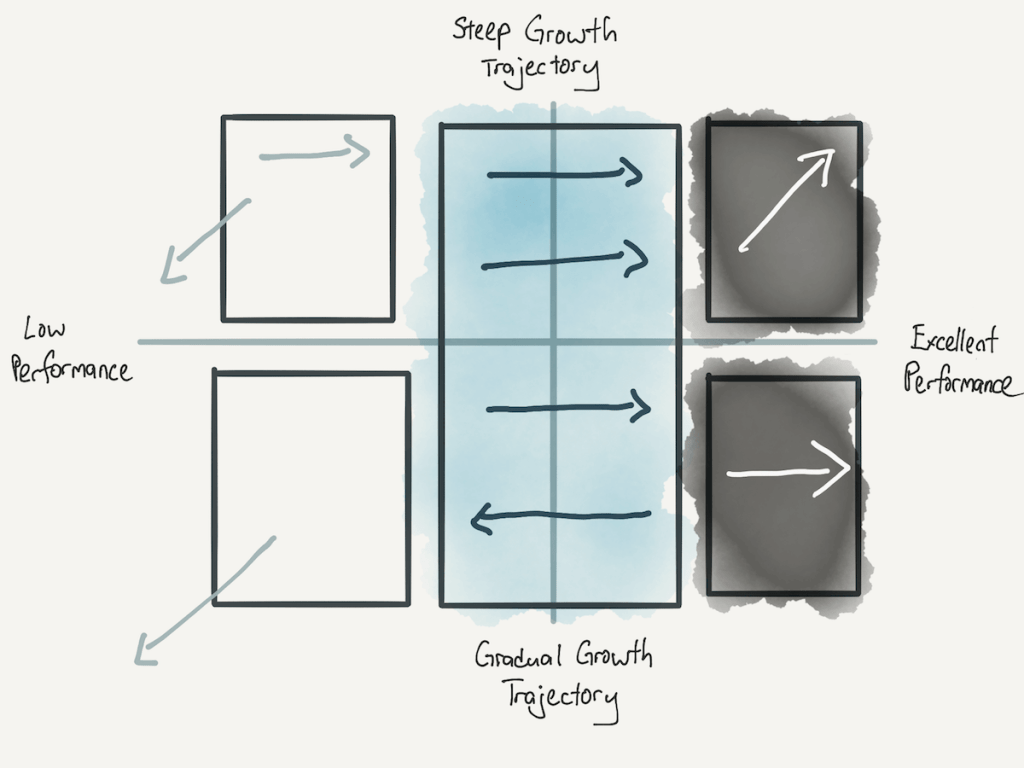
This illustration implies that only excellent performance matters; as a manager, your job is to push people until they hit peak performance (left to right movement). But once they’ve hit that level of performance, you should find ways to reward good performers regardless of their growth trajectories.
I would highly recommend this book as it provides actionable insights & pragmatic tactics that Scott has deployed throughout her life. The only critique is it may not be immediately suited to new managers but it will push you on a path to further your knowledge and level up.
 Bedroom 2 Boardroom 🚀