
One of the best books I’ve read on self-development is “Atomic Habits” by James Clear. In his book, he points out that people tend to overestimate the importance of one defining moment and underestimate the value of making small improvements every single day.
Atomic Habits is overflowing with actionable ideas on both habit building and habit breaking, thoughtfully organized, and engagingly written – a good read to start a new year off right.
There are 3 key points to learn from the book in my opinions:
- Every time we form a habit, there are four steps involved: cue, craving, respond and reward.
- To form new habits, the action need to have four qualities: easy, obvious, attractive and satisfying.
- Use some form of habit tracking to ensure you stick to your plan.
The Four Step Model of Habits
There are four steps to every habit:
- Cue
- Craving
- Response
- Reward
The cue is the trigger to start a behavior. The craving motivates you to take action. The response is the action itself. And the reward is the end goal of every habit.
The reward is the most important part of a habit. The cue is noticing the reward. The craving is wanting the reward. The response is getting the reward.
We can further break these steps into two phases:
- The Problem Phase
- The Solution Phase
In the problem phase, the cue is picked up on and the craving kicks in. In the solution phase, action is taken, and the reward is obtained.
Here is what the habit phases and steps look like:
Problem Phase
- Cue: You wake up
- Craving: You want to feel alert
Solution Phase
- Response: You drink a cup of coffee
- Reward: You satisfied your craving to feel alert
In this example, drinking coffee becomes associated to waking up.
Four Laws of Behavior Change
Now that we understand what defines a habit, its components, and how small changes to our habits can have profound effects, how do we go about changing our behavior?
James Clear once again breaks this down into four “laws”:
- The 1st Law (Cue): Make it obvious
- The 2nd Law (Craving): Make it attractive
- The 3rd Law (Response): Make it easy
- The 4th Law (Reward): Make it satisfying
If you are trying to break a bad habit, the inverse of these laws would apply:
- The 1st Law (Cue): Make it invisible
- The 2nd Law (Craving): Make it unattractive
- The 3rd Law (Response): Make it difficult
- The 4th Law (Reward): Make it unsatisfying
Strive To Be 1% Better Everyday
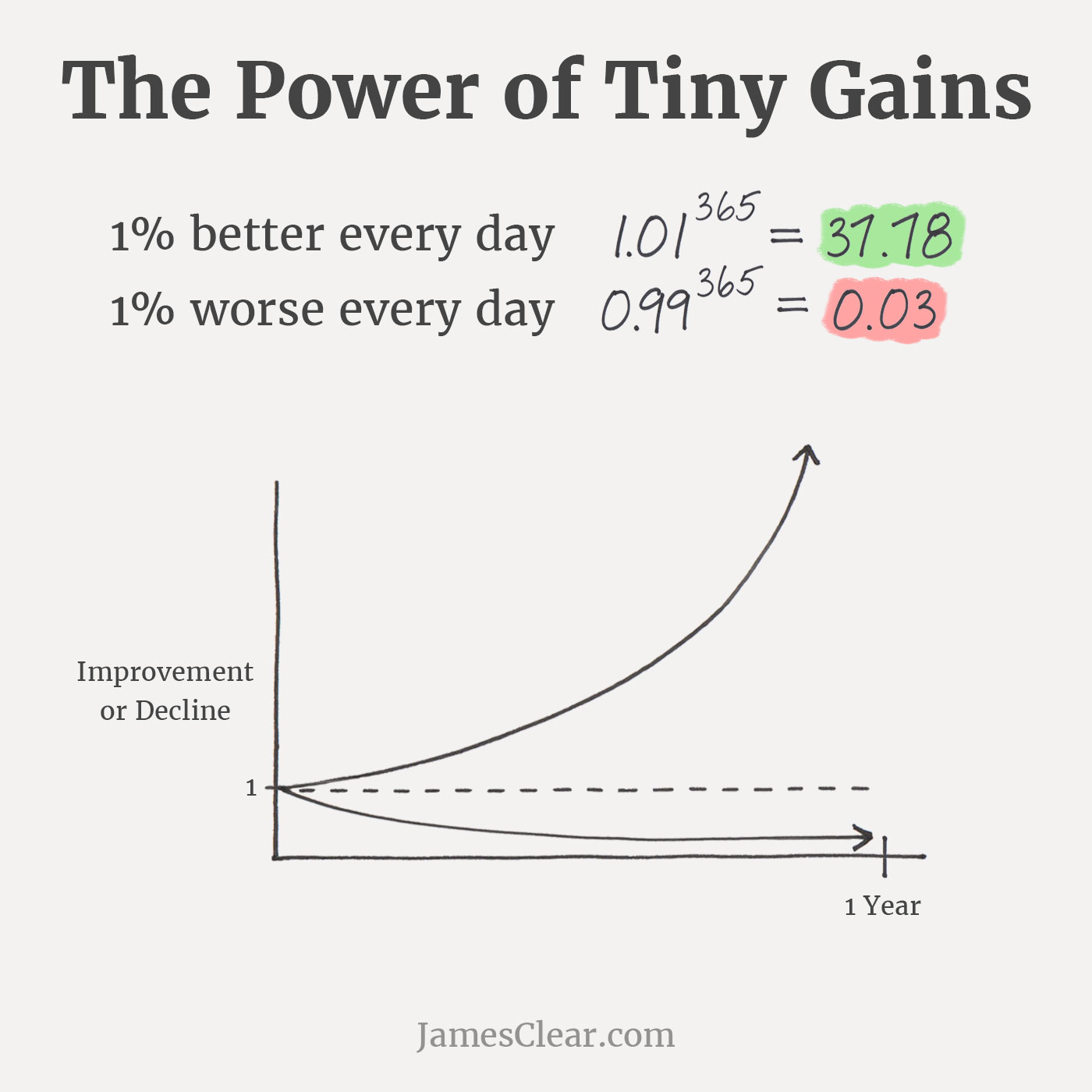
If you can get 1 percent better each day for one year, you’ll end up thirty-seven times better by the time you’re done. Conversely, if you get 1 percent worse each day for one year, you’ll decline nearly down to zero.
— Page 15
Becoming 1% better today may not seem like much, but with time, it can make a huge difference. Conversely, if you get 1 percent worse each day for one year, you’ll decline nearly down to zero. What starts as a small win or a minor setback accumulates into something much more.
- Saving $250 each week isn’t much, but it multiplies into $1,000 a month and $12,000 saved by the end of the year.
- Going to the gym 3 times in one week won’t get you in shape, but do it every week for a year and you’ll completely transform your body.
- Reading 15 pages a day is not a lot, but it accumulates into 105 pages a week, 420 a month, and 5,040 pages a year. An average book is 250 pages, so you’ll end up reading 20 books a year just from reading a little bit each day.
That being said, there is power in small improvements and slow gains. This is why average speed yields above average results. This is why the system is greater than the goal. This is why mastering your habits is more important than achieving a certain outcome.
Here are some easy habits to build
•The habit of exercising 20 minutes a day is enough to change your physique.
•The habit of eating healthier foods may add years to your life (and give you more vitality throughout).
•The habit of rising one hour earlier each morning to read would give you 365 extra hours more per year. At the average reading speed of 300 words per minute, this extra time would allow you to read 6,570,000 words, or 131 more 50,000 word books per year. That’s a LOT of books, and a sure way to increase your knowledge.
Where & what are the areas in your life where you can make those 1 percent improvements?
 Bedroom 2 Boardroom 🚀